New Fran ESG Podcast:Can Tourism Become a Force for Conservation?


Can Tourism Become a Force for Conservation?
What if travelling could do more than take us somewhere beautiful? What if tourism could protect biodiversity, create livelihoods, strengthen local communities and give people an economic reason to conserve the places they call home?
That is the conversation at the heart of the latest Fran ESG Podcast.
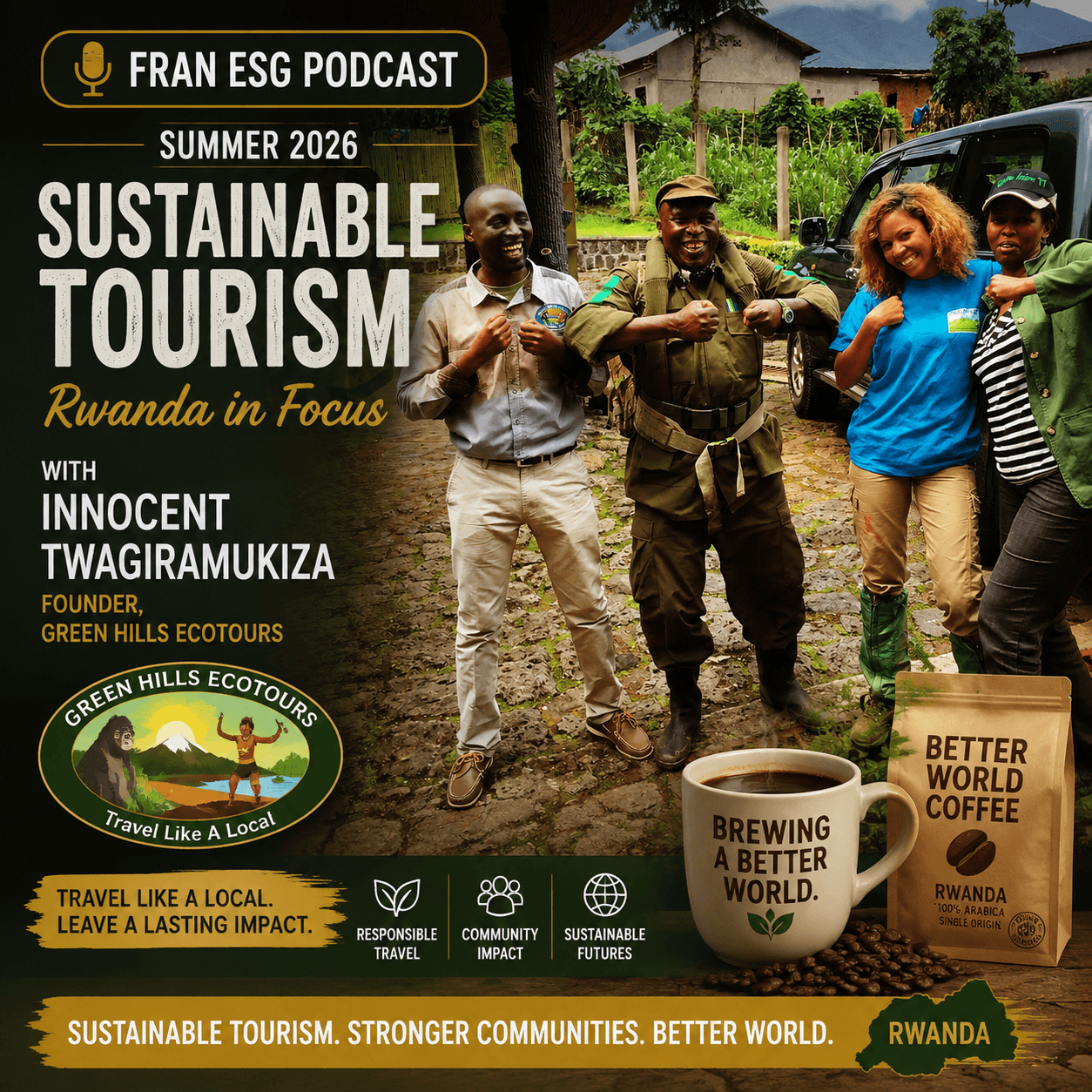
In our new episode, I travel—at least through conversation—back to Rwanda with Innocent Twagiramukiza, Founder of Green Hills Ecotours, to explore what sustainable tourism looks like when it moves beyond good intentions and becomes something practical.
Sustainable Tourism Is About More Than Being “Green”
Sustainable tourism is sometimes reduced to eco-lodges, reusable bottles or asking hotel guests not to wash their towels every day.
Our conversation goes much further.
For Innocent, responsible tourism means considering the impact tourism has on nature, local culture, livelihoods and the communities receiving visitors.
And that raises an important ESG question:
Who actually benefits from tourism?
If visitors enjoy extraordinary landscapes and wildlife while the surrounding communities see little economic benefit, can we really call that tourism sustainable?
When Conservation Creates Opportunity
One of the most powerful parts of our conversation concerns the relationship between tourism and conservation.
Tourism can undoubtedly put pressure on ecosystems when it is poorly managed. But it can also create an economic incentive to protect them.
When tourism creates jobs and revenue for communities living around important natural areas, conservation acquires a very different meaning.
People are no longer being asked simply to protect nature because someone else says they should. Protecting that environment can become connected to their own livelihoods and the future prosperity of their communities.
That is where sustainable tourism becomes particularly interesting from an ESG perspective: environmental protection and social development begin reinforcing one another.
Putting Local Communities at the Centre
Innocent’s approach through Green Hills Ecotours is based on giving travellers an authentic experience of Rwanda while creating opportunities for the people who live there.
That means looking beyond the traditional tourist itinerary and connecting visitors with local communities, culture, agriculture and entrepreneurship.
Experiences such as coffee and tea tours allow visitors to understand where products come from and meet some of the people behind them.
Instead of communities simply existing in the background of someone’s holiday photographs, they become active participants in the tourism economy.
And that matters.
Sustainable tourism should not only minimise negative impacts. It should create positive ones.
Brewing a Better World
Perhaps one of my favourite parts of our conversation is Innocent’s story about coffee.
His work eventually led him to create Better World Coffee, connecting Rwanda’s coffee culture with tourism and community development.
Coffee is something millions of us consume without thinking very much about the journey behind it.
But behind every cup are farmers, communities, land, water, livelihoods and an entire value chain.
By allowing travellers to experience that journey—from the farm towards the finished cup—tourism can create a connection between the consumer and the producer that rarely exists in conventional supply chains.
It is a small example of a much bigger sustainability principle:
When we understand where something comes from, we begin to understand its true value.
What Can Travellers Do?
Sustainable tourism isn’t solely the responsibility of governments, hotels or tour operators.
Travellers make choices too.
Where do we stay?
Who organises our excursions?
Where do we eat?
What do we buy?
Do we choose locally owned businesses?
Do the people whose culture, landscapes and wildlife we have travelled thousands of kilometres to experience actually benefit from our presence?
Responsible travel does not necessarily mean giving up extraordinary experiences.
It means becoming more conscious about who and what our travel supports.
What Tourism Can Teach Us About ESG
Although this episode focuses on tourism, I think its message goes much further.
The best sustainability strategies do not treat the E, the S and the G as three separate boxes.
Protecting an ecosystem can create economic opportunity.
Creating local livelihoods can strengthen conservation.
Responsible business models can generate commercial value while producing positive social outcomes.
That is ultimately what ESG should be about: understanding these connections and building better business models around them.
🎙️ Listen to the New Fran ESG Podcast
In this episode, Innocent Twagiramukiza, Founder of Green Hills Ecotours, and I discuss:
- what sustainable tourism really means;
- how tourism can contribute to conservation;
- protecting wildlife and biodiversity;
- ensuring local communities benefit from tourism;
- Rwanda’s experience with responsible tourism;
- the business case for sustainability;
- what travellers themselves can do differently;
- and how Better World Coffee connects tourism, agriculture and community livelihoods.
If you work in ESG, tourism, hospitality, conservation, community development or responsible business—or you’re simply someone who loves travelling—I hope this conversation makes you think a little differently about your next journey.
🎧 The Sustainable Tourism episode of the Fran ESG Podcast is now available on Spotify.
And perhaps the question to take with you on your next trip is a simple one:
Will the place I visit be better because I was there?
https://carrongesggroup.com/media
The Fran ESG Podcast brings together sustainability leaders, entrepreneurs, researchers and practitioners from around the world to explore what ESG looks like in practice.
The podcast is hosted by Francine Carron, Founder and CEO of ESG Consultancy.
For ESG strategy, international sustainability advisory, training and practical ESG implementation, visit www.esg-consultancy.be