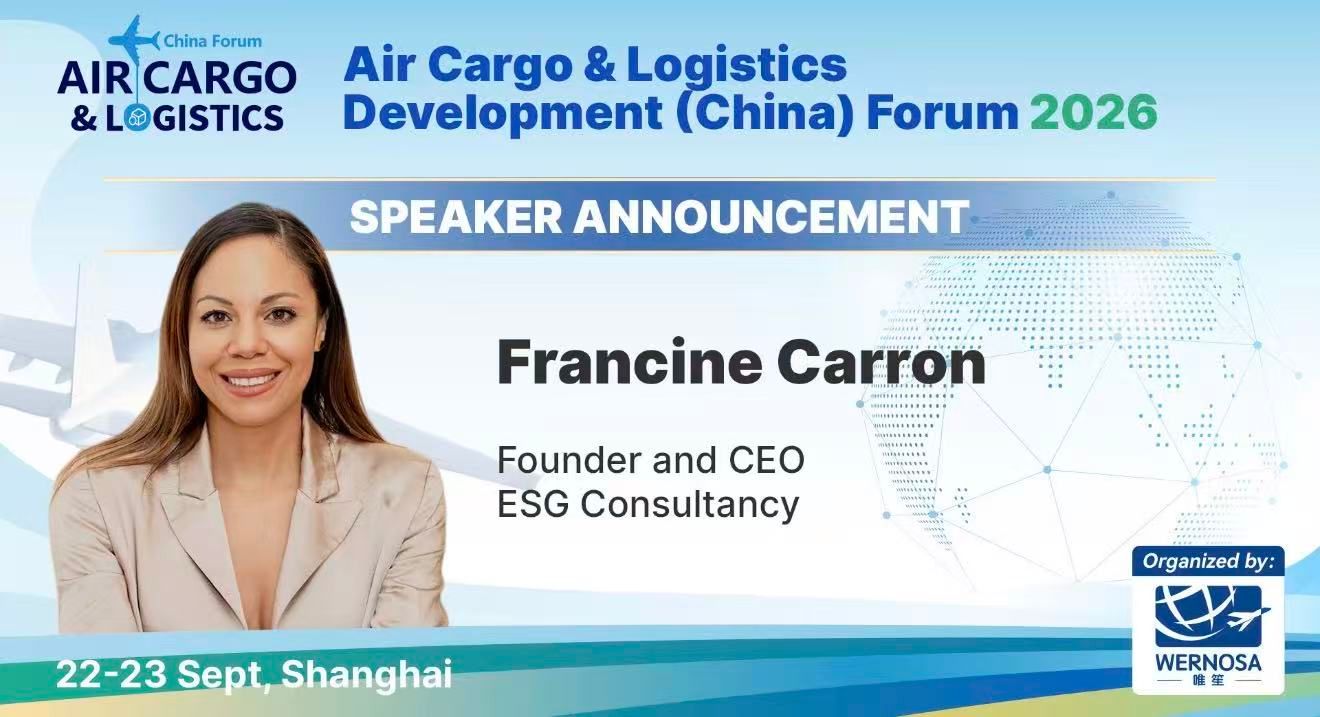
Francine Carron to Speak on ESG and SAF Transformation in Air Cargo at Shanghai Forum 2026
ESG Consultancy Founder & CEO Francine Carron will speak at the Air Cargo & Logistics Development China Forum 2026 in Shanghai on 22–23 September, addressing the growing commercial importance of ESG and Sustainable Aviation Fuel (SAF) for the air cargo industry.
Sustainable Skies: Navigating SAF Adoption & ESG Transformation in Air Cargo
The session will focus on a question that is becoming increasingly important for the global air cargo sector:
How can companies move ESG and SAF from sustainability commitments into practical business implementation?
Sustainability is no longer only a reporting or regulatory issue. It is increasingly connected to how customers select suppliers, how procurement decisions are made, how companies manage risk and how aviation prepares for its transition towards lower-carbon operations.
ESG is becoming a commercial issue
One of the central messages of my session will be simple:
ESG is not a report. It is how you run the company.
For air cargo companies, ESG can touch almost every part of the operation.
Environmental performance includes energy and fuel consumption, emissions, vehicles and ground equipment, cargo facilities, packaging, waste and operational efficiency.
Social performance includes health and safety, employee training and development, workforce stability and inclusion.
Governance determines who is responsible, how targets are managed, whether sustainability is considered in procurement and whether the company can provide reliable evidence behind its sustainability claims.
These issues are also becoming relevant when customers evaluate their logistics and air cargo partners.
TIACA’s 2026 Sustainability Insights Report found that 70% of respondents incorporate sustainability into procurement decisions.
This creates a very practical commercial question for the industry:
What happens when your price is competitive, but you cannot answer your customer’s ESG questions?
Connecting ESG with SAF
The second major focus of the Shanghai session will be Sustainable Aviation Fuel.
SAF is often discussed separately from ESG, but in practice the two are closely connected.
Purchasing SAF is not simply a fuel decision. It involves procurement, finance, suppliers, customers, emissions accounting, sustainability claims and management responsibility.
An ESG framework provides the structure through which these decisions can be managed and measured.
At the same time, the challenges surrounding SAF are real. Supply remains limited, and costs remain substantially higher than conventional aviation fuel in many markets.
Rather than ignoring those barriers, the industry needs practical commercial approaches for working with them.
Practical SAF examples from around the world
At Truckee Tahoe Airport in California, the airport transitioned its jet-fuel offering to a SAF blend. Its experience demonstrates how procurement strategy, partnerships, incentives and local market conditions can influence the economics of SAF adoption.
In Singapore, SAFCo has developed a central procurement approach that aggregates demand rather than requiring every organisation to procure SAF independently.
The first voluntary procurement trial brought together nine participants, including Changi Airport Group, Singapore Airlines, Scoot, Google and Temasek. Singapore’s Civil Aviation Authority describes the model as a way to aggregate demand and enable more efficient SAF procurement.
For air cargo specifically, Finnair Cargo lets customers contribute to SAF and receive documented emissions benefits through a Book & Claim approach.
These models are different, but they demonstrate an important principle:
The industry does not have to wait for the SAF challenge to disappear before it starts looking for solutions.
Start with what can be done today
Not every air cargo company can make a major SAF investment immediately.
But sustainability transformation does not begin and end with SAF.
Companies can already examine energy consumption, equipment utilization, waste, employee training, ESG responsibilities, sustainability data and supplier management.
Larger investments — including fleet renewal, infrastructure, renewable energy, new technology and SAF — can then form part of a longer-term transition.
The important thing is to know where the organisation stands today and what it needs to do next.
See you in Shanghai
Through ESG Consultancy and Haikou ESG, we support aviation and air cargo organisations with practical ESG strategy and implementation, sustainability assessment, TIACA BlueSky support, carbon management and sustainable procurement.
Through ESG Academy, we provide practical ESG and sustainability training for aviation and air cargo teams.
And through ESG Fuels, we support organizations exploring SAF and low-carbon fuel opportunities.
https://mailchi.mp/esg-consultancy.be/cargoforumshanghai
Conference program: https://www.wernosa.com/col.jsp?id=107